+251 99 380 2995 | +251 97 022 2227 | [email protected]


Sound Sensor
Br 600.00
- The sound sensor module is a small circuit board that includes a microphone, an LM393 High Precision Comparator chip, and some additional electronic components that help detect the sound signals.
- Operating voltage 3.3V-5V
- Outputs digital switching output (high and low levels 0 and 1)
- Operating current (Vcc=5V): 4-8mA
- Microphone sensitivity (1Khz): 52-48dB
- Microphone Impedance: 2.2KΩ
- Microphone Frequency: 16-20Khz
- Microphone S/N ratio: 54dB
- Signal output indication
- Single channel signal output
- Outputs low level and the signal light when there is sound
- The microphone picks up sound waves from the environment, typically within a frequency range between 50Hz and 10kHz. It then converts these sound waves into analog voltage signals. On the module, there’s a potentiometer (a small knob) that allows you to adjust how sensitive the sensor is. In simpler terms, this lets you set a threshold or limit for detecting sound. When you turn the knob counterclockwise, the sensor becomes more sensitive and will detect quieter sounds. If you turn it clockwise, it becomes less sensitive and will only detect louder sounds. The LM393 comparator chip plays an important role. It compares the analog signals from the microphone to the threshold level you have set with the potentiometer. If the incoming sound is louder than your threshold, the sensor’s output will switch to LOW. If the incoming sound is quieter than the threshold, the output stays HIGH. This feature allows you to configure the sensor to respond only to sounds that exceed a certain loudness. This capability is particularly useful in projects where you want specific actions triggered by sound. For example, you can set the sensor to activate a relay and turn on a light whenever someone claps loudly.
- It allows you to build sound-reactive projects—like clap-activated lights, noise-sensitive alarms, or even fun interactive gadgets.
Pin Configuration
- OUT – is the output pin. When the sound level is louder than the threshold you set using the potentiometer on the board, the OUT pin sends a LOW signal. When sound is quieter than the threshold, it sends a HIGH signal. You can connect this pin to any digital pin on an Arduino or directly to a 5V relay module to control other devices.
- GND – is the ground pin.
- VCC – is used to supply power to the module. You should connect it to a voltage source between 3.3V and 5V.
Applications
- Hearing aids
- Telephones
- Tape recorders and karaoke
- Live and recorded audio engineering
- Radio and television broadcasting
- Speech recognition technology
You may also like…
-

Sound Detection Sensor
Br 600.00 -

Voice Record and Playback Module ISD1820
Br 650.00 -

Voice Recognition Module V3.1
Br 5,500.00 -
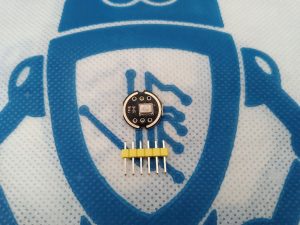
Omnidirectional Microphone Module INMP441
Br 750.00
Related products
-

Vibration Sensor
Br 600.00 -

MT8870 DTMF Decoder Module
Br 550.00 -

MP3 Decoder Board
Br 500.00 -

Audio Amplifier PAM8302
Br 450.00