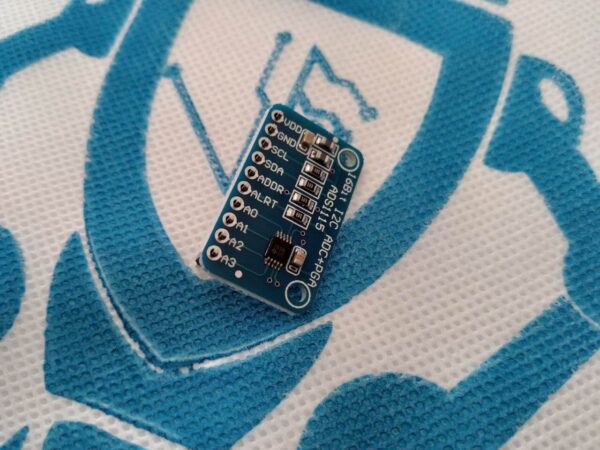
The ADS1115 is a 16-bit precision analog-to-digital converter capable of 860 samples/second over I2C. It has four input channels, which can be used as four single-ended, or two differential channels.
Wide Supply Range: 2.0V to 5.5V
Continuous Mode: Only 150µA
Programmable Sample Rate: 8 to 860 Samples/Second
Internal Low-Drift Voltage Reference
Internal oscillator
Internal programmable gain amplifier (PGA), which can be configured for gains up to x16, to amplify small analog signals to the full available range
I2C Interface: Pin-Selectable Addresses
Default I2C Address: 0x48
This board/chip uses I2C 7-bit addresses between 0x48-0x4B, selectable with jumpers
The module can be powered with supply voltages between 2V to 5.5V, which makes them compatible with all common 3.3V and 5V microcontrollers and processors, such as Arduino and Raspberry Pi.
The module’s I2C address can be configured for one of four available addresses making it possible to connect up to four of these modules to the same I2C bus. So, you can effectively add up to 16 additional analog inputs to your Arduino or other microcontroller.
For microcontrollers without an analog-to-digital converter or when you want a higher-precision ADC, the ADS1115 provides 16-bit precision at 860 samples/second over I2C.
The chip can be configured as 4 single-ended input channels, or two differential channels. As a nice bonus, it even includes a programmable gain amplifier, up to x16, to help boost up smaller single/differential signals to the full range.
It can run from 2V to 5V power/logic, can measure a large range of signals and its super easy to use. It is a great general purpose 16 bit converter.
If you want to measure voltages much higher than the max analog input (AIN) then you can use a couple of resistors to make a voltage divider that will give you a voltage within the range of this module and then use this module to precisely measure that voltage.
Single-Ended Vs. Differential Analog Inputs:
Single-Ended analog inputs measure the voltage between the analog input pin (A0-A3) and ground (GND).
With the ADS1115, measuring voltage in a single-ended configuration will effectively only provide a 15-bit value, since the 16th bit is a sign bit (the device uses signed integer values).
Differential analog inputs measure the voltage between two analog input pins, such as A0 & A1 or A2 & A3.
When measuring voltage in a differential configuration you will get the full 16 bits of resolution since you can now measure negative values. Also, differential measurements are more immune to signal noise.
You can select from one of four available addresses by connecting the ADDR pin as listed below. The board has a pull-down resistor that connects ADDR to GND for a default address of 0x48.