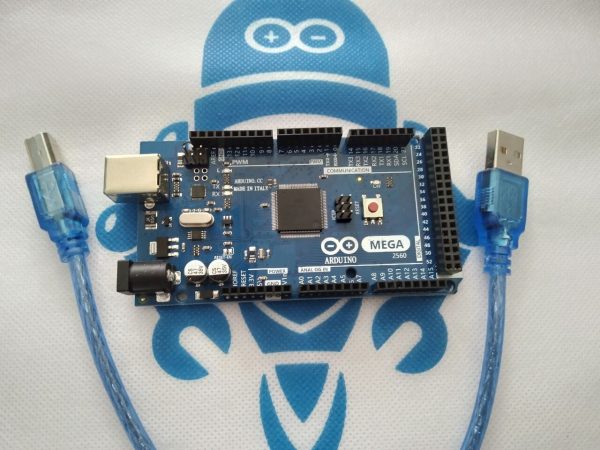
The Arduino Mega 2560 is a microcontroller board based on the ATmega2560 chip, designed for projects that require a large number of input/output (I/O) pins and more processing power than smaller boards like the Arduino Uno.�It features 54 digital I/O pins, 16 analog inputs, 4 hardware serial ports, and 256KB of flash memory, making it ideal for complex projects such as 3D printers, robotics, and data-intensive applications.�
Operating Voltage 5V
Input Voltage (recommended) 7-12V
Input Voltage (limits) 6-20V
Digital I/O Pins 54 (of which 15 provide PWM output)
Analog Input Pins 16
DC Current per I/O Pin 40 mA
DC Current for 3.3V Pin 50 mA
Flash Memory 256 KB of which 8 KB used by bootloader
Arduino Mega 2560 is a Microcontroller board based on Atmega2560. It comes with more memory space and I/O pins as compared to other boards available in the market.
There are 54 digital I/O pins and 16 analog pins incorporated on the board that make this device unique and stand out from others.
Out of 54 digital I/O, 15 are used for PWM (pulse width modulation).
A crystal oscillator of 16MHz frequency is added on the board.
This board comes with USB cable port that is used to connect and transfer code from computer to the board.
DC power jack is coupled with the board that is used to power the board. Some version of the Arduino board lacks this feature like Arduino Pro Mini doesn’t come with DC power jack.
ICSP header is a remarkable addition to Arduino Mega which is used for programming the Arduino and uploading the code from the computer.
This board comes with two voltage regulator i.e. 5V and 3.3V which provides the flexibility to regulate the voltage as per requirements as compared to Arduino Pro Mini which comes with only one voltage regulator.
Arduino software called Arduino IDE is used to program the board which is a common software used for all boards belonged to Arduino family.
Availability of Atmega16 on the board makes it different than Arduino Pro Mini which uses USB to serial converter to program the board.
There is a reset button and 4 hardware serial port called USART which produces a maximum speed for setting up communication.
Arduino Mega is specially designed for the projects requiring complex circuitry and more memory space. Most of the electronic projects can be done pretty well by other boards available in the market which make Arduino Mega uncommon for regular projects. However, there are some projects that are solely done by Arduino Mega like making of 3D printers or controlling more than one motors, because of its ability to store more instructions in the code memory and a number of I/O digital and analog pins.
There are three ways to power the board. You can either use a USB cable to power the board and transfer code to the board or you can power it up using Vin of the board or through Power jack or batter.
Last two sources to power the board are required once you already built and compile code into the board through USB cable.
This board comes with resettable polyfuse that prevents the USB port of your computer from overheating in the presence of high current flowing through the board. Most of the computers come with an ability to protect themselves from such devices, however, the addition of fuse provides an extra layer of protection.
It can be used either way i.e. for creating stand-alone projects or in combination with other Arduino boards. Most complex projects can be created using this board.
Arduino Mega 2560 is an ideal choice for the projects requiring more memory space to used with more number of number pins on the board. Following are the main applications of the Arduino mega boards.