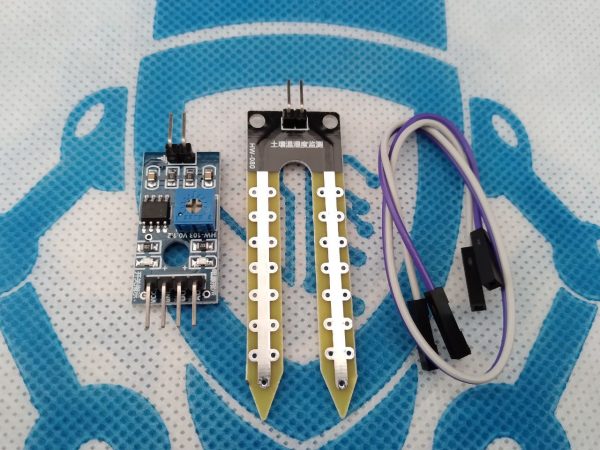
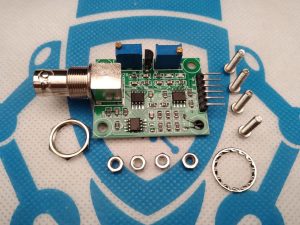
A soil moisture sensor measures the water content in soil and is used in agriculture, gardening, and research to determine the moisture needs of the soil.�These sensors typically use two probes to measure soil’s resistance, which changes with moisture.
Operating Voltage: 3.3V to 5V DC
Operating Current: 15mA
Output Digital – 0V to 5V, Adjustable trigger level from preset
Output Analog – 0V to 5V based on infrared radiation from fire flame falling on the sensor
LEDs indicating output and power
PCB Size: 3.2cm x 1.4cm
LM393 based design
Easy to use with Microcontrollers or even with normal Digital/Analog IC
This soil moisture sensor module is used to detect the moisture of the soil.
It measures the volumetric content of water inside the soil and gives us the moisture level as output.
The module has both digital and analog outputs and a potentiometer to adjust the threshold level.
The consists of two probes that are used to detect the moisture of the soil.�The moisture sensor probes are coated with immersion gold that protects Nickel from oxidation. These two probes are used to pass the current through the soil and then the sensor reads the resistance to get the moisture values.
Moisture sensor module consists of four pins i.e. VCC, GND, DO, AO. Digital out pin is connected to the output pin of LM393 comparator IC while the analog pin is connected to Moisture sensor.
When there is more water presented in the soil, it will conduct more electricity that means resistance will be low and the moisture level will be high.